
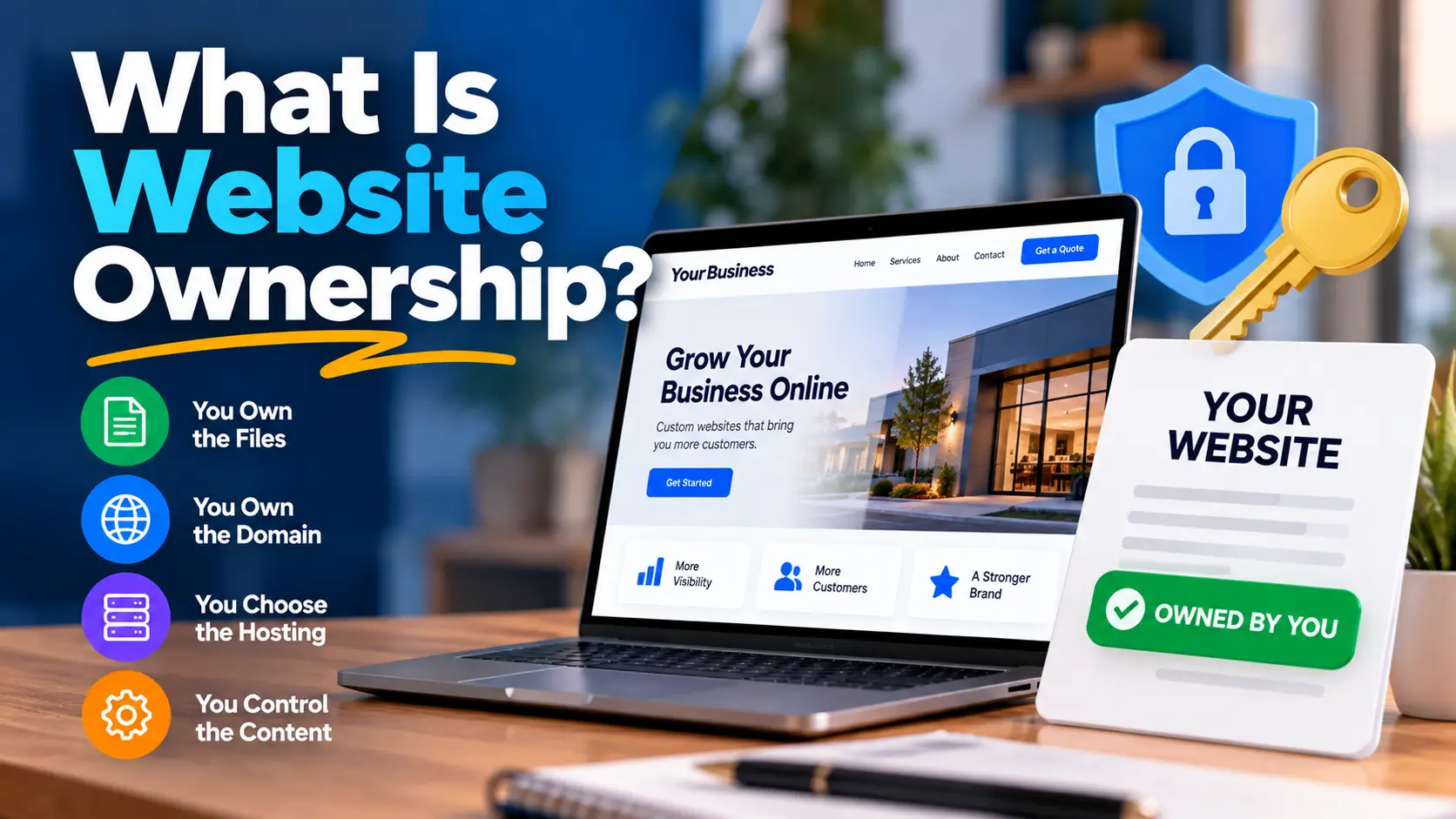
What does it actually mean to own a website?
For a small business, website ownership means having control over the important assets that make up your website, including your domain, hosting, website files, content, and accounts.
Hiring a web designer does not necessarily mean giving them ownership of your website. Ideally, your developer manages the website for you while your business maintains control of the important assets.
In simple terms:
You should be able to access your website, manage its important accounts, keep a backup, and move to another provider or developer if you ever need to.
If website ownership is important to your business, you can also learn more about website ownership with GetOwnWeb.
What is website ownership?
Website ownership is the combination of control, access, and rights you have over the assets that make up your website.
These assets can include:
- Domain name
- Hosting account
- Website files
- Website content
- Images and brand assets
- Database
- Source code
- Business email
- Analytics
- Search accounts
- Backups
Not every asset is necessarily owned in exactly the same way. For example, a premium plugin, stock image, font, or third-party software may be licensed rather than owned outright.
That is why paying for a website does not automatically answer the question of who owns it. Your contract, account ownership, licensing terms, and ability to access and transfer the website all matter.
What parts of your website should you control?
1. Domain name
Your domain is your website address, such as yourbusiness.com. Your business should ideally control the domain registrar account.
Your web designer can manage DNS settings or other technical details, but you should know:
- Where the domain is registered
- Who controls the account
- How to access it
- When it expires
- How to transfer it
Owning your domain does not automatically mean you own or control the website behind it.
2. Website files
Your website files are the files that make your website work. Depending on your platform, these could include:
- HTML
- CSS
- JavaScript
- PHP
- Images
- Theme files
- Other website assets
If your website is custom-built or self-hosted, you should know whether you can access and download these files. This becomes especially important if you ever change developers.
3. Website content
Your website content may include:
- Service descriptions
- Blog posts
- Images
- Videos
- Product information
- Testimonials
- Case studies
- Downloadable documents
Your business should understand what rights it has to the content it provides or commissions. If your designer creates content for you, check your agreement to understand whether the content is transferred to you or licensed for your use.
4. Hosting
Hosting is where your website lives. Your hosting account can contain your website files, database, backups, SSL settings, and other important infrastructure.
Your developer can manage your hosting, but your business should ideally retain appropriate access to the hosting account. The goal is simple:
Your developer should be able to manage your website without becoming the only person who can access it.
5. Source code and design
This area can be more complicated. If your website uses custom code, themes, plugins, fonts, images, or other third-party assets, your agreement should explain what you own and what you are licensed to use.
For example, you may own custom code created specifically for your business while a third-party plugin remains subject to its own license. Do not assume that paying a one-time development fee automatically means you own every piece of software used on your website.
Website ownership vs domain ownership
Website ownership and domain ownership are not the same thing.
Your domain is your web address. Your website includes the files, content, database, design, hosting, and other components behind that address.
For example, you might control the domain:
yourbusiness.com
while your agency controls:
- Hosting
- Website files
- Backups
- CMS
- Database
In that situation, you control the domain but may not have full control over the website. That is why you should ask both:
Do I own my domain? and Can I access and transfer my website?
Renting a website vs owning a website
Some companies provide websites through a monthly subscription. You pay a recurring fee, and the provider manages the website and platform. That can be convenient, but you should understand what happens if you cancel.
| Renting a website | Owning / controlling a website | |
|---|---|---|
| Domain | May be provider-managed | Business-controlled |
| Website files | May not be portable | Accessible / portable |
| Hosting | Provider-controlled | Business-controlled or accessible |
| Developer | May be tied to provider | Can change developers |
| Migration | May require rebuilding | Usually easier |
| Long-term control | Depends on provider | Greater control |
The payment model itself does not determine ownership. A one-time payment does not automatically mean you own everything, and a monthly payment does not automatically mean you own nothing.
Your contract and actual control of the assets matter.
Can you move your website to another developer?
One of the simplest ways to think about website ownership is portability. If you stop working with your current developer, can another qualified developer take over?
You should ideally be able to provide access to the relevant:
- Domain
- Hosting
- Website files
- CMS
- Database backup
- Analytics
- Search Console
- Other necessary accounts
The exact process depends on how your website was built. A portable website gives your business more flexibility because you are not completely dependent on one developer.
How to check if you own your website
Not sure who controls your website? Use this checklist.
- I control my domain registrar account
- I can access my hosting account
- I have website administrator access
- I can obtain a website backup
- I know where my website files are stored
- I control my business email
- I control my analytics account
- I have appropriate Google Search Console access
- I understand who owns or licenses the website code
- I can hire another developer if necessary
- My contract explains website ownership
If you cannot check several of these boxes, it is worth finding out exactly who controls your website.
What happens if your web designer disappears?
This is one of the biggest reasons website ownership matters. Imagine your web designer suddenly:
- Closes their business
- Stops responding
- Raises their prices
- Ends your contract
- Loses access to your website
If they control your domain, hosting, files, and backups, moving forward can become difficult. If your business controls the important accounts and has access to the website assets, you can generally work with another developer without starting from scratch.
The goal is not to prevent your developer from having access. The goal is to make sure:
Your developer is not the only person who has access to your business's website assets.
Does website ownership affect SEO?
Website ownership itself is not a Google ranking factor. However, controlling your website gives you greater control over the things that can affect SEO.
For example, if you control your domain, website files, CMS, content, redirects, internal links, metadata, structured data, analytics, and Search Console, you can make technical and content changes without depending entirely on another company. It can also make website migrations easier to manage.
So the relationship is indirect:
Owning your website does not automatically improve SEO, but having control over your website makes it easier to manage your SEO.
What should a website ownership agreement include?
Before paying someone to build your website, make sure your agreement clearly explains ownership and access. Depending on the project, consider documenting:
- Domain: Who registers and controls it?
- Hosting: Who owns the hosting account?
- Website files: Can you access or receive them?
- Source code: Is custom code owned by you or licensed to you?
- Content: Who owns the copy, images, and other materials?
- Third-party assets: Which themes, plugins, fonts, and images are licensed?
- Backups: How are backups created and accessed?
- Accounts: Which accounts should your business control?
- Migration: Can another developer take over?
- Termination: What happens when the relationship ends?
A clear agreement can prevent many ownership disputes later.
What website ownership looks like at GetOwnWeb
At GetOwnWeb, we believe small businesses should have meaningful control over their websites. That means your website should not become something you are permanently dependent on one company to access or manage.
If you want to understand exactly how GetOwnWeb approaches website ownership, visit our Website Ownership page.
If you are building a new website, you can also explore our website design services. And if you already have a website but do not have control over its important assets, a website redesign can be an opportunity to establish a better ownership structure.
Final takeaway
Your website can become one of your business's most valuable digital assets. Before hiring a web designer, do not only ask:
"How much does the website cost?"
Also ask:
"What will I own, what will I control, and can I move the website if I change providers?"
At a minimum, make sure you understand who controls your domain, hosting, website files, content, backups, email, analytics, and other important accounts. You do not have to manage everything yourself. A professional can build and maintain your website while your business retains appropriate control.
Hire someone to manage your website without making your business dependent on them to own it.
Learn more about website ownership with GetOwnWeb →
Frequently asked questions
What does website ownership mean?
Website ownership means having appropriate control and rights over the important assets that make up your website, including your domain, hosting, files, content, and applicable code.
Does owning my domain mean I own my website?
No. Your domain and website are separate assets. You can control your domain while another company controls your website files or hosting.
Should my web designer own my domain?
Your business should generally control its domain registrar account. Your web designer can have access to manage it without being the sole account holder.
Can I move my website to another developer?
If your website and its important assets are portable, you should be able to move to another qualified developer. The exact process depends on your website platform and technology.
Does website ownership improve SEO?
No. Website ownership itself is not a ranking factor. However, controlling your website gives you more freedom to make the technical and content changes that support SEO.
How do I know if I own my website?
Check who controls your domain, hosting, website administration, files, backups, analytics, email, and relevant intellectual-property rights. Your contract should also clearly explain ownership and licensing.